
Selections from the
Eugene Friends Meeting Library
Quick Links
- Eugene Friends Meeting Library Catalog
- Book Review – Encounters with Silence by John Punshon
- Book Review – The History of the Rise, Increase, and Progress of the Christian People called Quakers, by William Sewel
The Guided Life: Finding Purpose in Troubled Times, By Craig Barnett
The Guided Life: Finding Purpose in Troubled Times (Craig Bennett) joins EFM’s library’s recent acquisitions that seem to focus on the question of “what do we do now?” Published in the UK in 2019 (midway through Donald Trump’s first term), that question is perhaps pertinent to Friends now more than ever. Bennett states the concern clearly in Chapter 1: “The world needs guided men and women, not guided missiles”, and Quakers “have made the cultivation of the guided life the focus of [their] practice for over three centuries.”
To what purpose do we seek guidance for living our lives? Simply, “for the healing of the world, through us.” This is no easy task, to be sure: the guided life “does not serve our comfort, self-image or security.” But if we are committed to personal integrity as a primary value, “we cannot surrender responsibility for our own lives by submission to authority or conformity to any group.” Perhaps paradoxically, when we consent to being led, we will find ourselves sustained, nourished and fulfilled.
The bulk of this little book consists of the author’s reflections on how this guidance can come to us and how we may be led to respond.
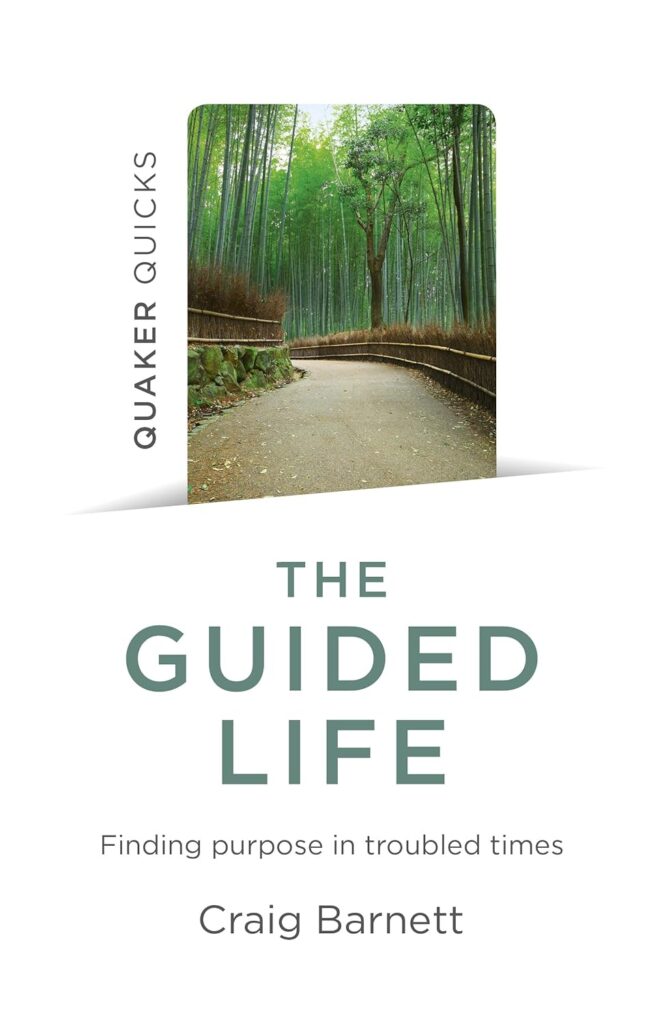
In four sections, Bennett describes the basics of Quaker practice as he has experienced it, largely in the unprogrammed tradition. The first chapter makes the case for the absolute necessity of seeking and committing to follow the guidance of Spirit as it reveals itself to us internally. Chapter 2 explains the value of the supportive community of Friends for, among other things, testing the trueness of our inner leadings. In “The Broken Life”, the third chapter, we read of the need for continuing guidance as we muddle through the world, making mistakes even as we are well-intentioned. Finally, in the last chapter, we are advised to “choose life”, perhaps in a reference to Deuteronomy 30:19. Bennett describes for us the ethical principles by which he tries to live, his personal testimonies: stillness, simplicity, forgiveness, truthfulness, friendship, living adventurously. The suggestion is for all of us to seek through determined Quaker practice to find and live in accordance with our own testimonies.
This is Bennett’s prescription for finding purpose in these troubled, troubling times: go within first, become grounded in the guidance of Spirit, then live life faithful to that guidance. One can do no more than this, but this is sufficient.
Encounters with Silence: Reflections from the Quaker Tradition, by John Punshon
John Punshon gives us, in this extended essay, not only a deep look at unprogrammed worship in the manner of Friends, but also his personal story of growth in faith. Punshon (1935-2017), born in London, was shipped off to the country to escape the Blitz, where he was exposed to Baptist worship and practice. As a young man at Oxford, he regularly attended Anglican services, but eventually became a convinced Quaker member. His adult life was spent teaching and writing (our library has two of his other books), but, as he makes clear in Encounters with Silence, his work and the development of his spiritual life went hand-in-hand.
Although he writes in common, non-technical language, Punshon is a theologian, and one should not expect a light read. In particular, his view that Quaker silent worship is not far at all removed from the Roman Catholic mass in terms of its ritualistic emphasis was for me rather confusing. However, an over-arching theme is that all forms of religious worship are good and to be respected, and in fact all religions are very similar at their deepest levels. This is presented in clear and unequivocal terms.
Two caveats may be in order here. First, Punshon is undeniably Christian, a fact that he states puts him at odds with many liberal Friends. Secondly, our library copy was donated to us and contains lots of underlining and marginalia, fortunately done in #2 1/2 or #3 pencil, so one can read them or overlook them as one chooses.
The History of the Rise, Increase, and Progress of the Christian People called Quakers, third edition, by William Sewel
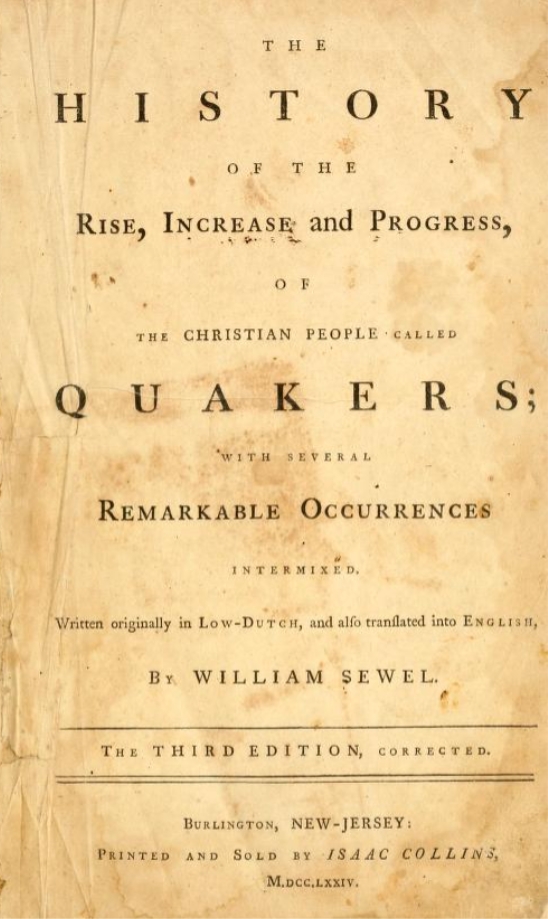
Here is a massive history of early Quakerism, written by a contemporary. Beginning with a brief account of the early Protestant Reformation, William Sewel (1653-1720) introduces us to George Fox and details his spiritual quest that leads to his convincing/conversion in 1647. Using George Fox’s Journal and an apparently enormous accumulation of correspondence and interview notes, the author presents a chronological report, based on first-hand accounts, of the first seventy years of Quaker activity. The stories of the early Friends’ evangelizing efforts and consequent intense persecution are told in the context of the tumultuous political events of the time: civil war, regicide, the protectorate of Cromwell, the Stuart restoration, the Glorious Revolution, etc. These are stories of deep religious devotion and personal integrity, heroic and intensely inspiring.
Why would one read this book? It’s 812 pages of 10-font archaic English (where the “s” often looks like an “f” but sometimes not). It takes commitment and time to get through it. But there was something quite moving to this reader about touching the very pages and reading the very print of a book printed over 250 years ago. And one learns things. One learns that original Quakerism was undoubtedly Christian, and the Bible was important: the well-known refusal to swear oaths, for which many suffered greatly, was based on scriptural dictate. One also sees how the earliest, somewhat aggressive, evangelizing efforts changed to a quieter activity as more people became convinced. One learns about some misguided Quakers, apostates; and there is a long section on the errors and ultimate repentance of James Naylor. One realizes that the foundational principles of peace, equality, integrity, community, etc., valorized throughout the History, still provide the cohesive values for our Society today.
The organizational structure of the Society as described in the History still exists. One can see where we came from. And also one sees clearly how we have changed with the times.
The result of 25 years of his labor, Sewel first published his History in Holland in 1717. It was translated into English and printed in London in 1722. The edition in possession of our library was printed, we believe (the original title page is missing), in New Jersey in 1774. Thanks to the generosity of a Meeting member, this remarkable text is presently in circulation.
Updated: 6/22/2025